Mobile Midwife
AbhishekMobile Midwife project in Ghana
BackgroundThe republic of Ghana is a middle income country and is ranked as a lower middle income economy by the World Bank. The country has an estimated population of about 23.4 million (GSS, 2009) with a population density varying from 897 per km [1]. One of the main problems confronting Ghana is its high maternal mortality rate. Figures from the WHO, UNICEF and UNFPA for Ghana indicate 740 maternal deaths in 1990, 590 in 1995, 540 in 2000 and 560 in 2005 per 100,000 live births [2]. In Ghana, several interventions targeting the reduction of maternal mortality have been implemented. Notable among these is the mobile midwife project implemented through Mobile Technology for Community Health (MOTECH) initiative in Ghana, a partnership between Ghana Health Service, Grameen Foundation and Columbia University’s Mailman School of Public Health. Funded by a grant from the Bill & Melinda Gates Foundation, the project aims to determine how to use mobile phones to increase the quantity and quality of prenatal and neonatal care in rural Ghana, with a goal of improving health outcomes for mothers and their newborns. The MOTECH system was launched in July 2010 in the Upper East Region of Ghana [3].

Project Details
The mobile midwife project in northeast Ghana is part of the ‘Mobile Technology for Community Health’ (MoTeCH) project. It aims to improve antenatal and neonatal care among the rural poor and to empower women to take control over their own health. Voice or text messages provide relevant health information during the pregnancy and encourage women to seek antenatal care. After the birth of the child information on essential vaccinations and the management of critical childhood diseases is sent. In addition, community health workers can keep electronic records and retrieve patient information using their mobile phone. In its first phase beginning in 2010, the project has been implemented in the upper eastern region of Ghana, which is the least urbanized region and comprises mainly of rural population scattered in dispersed settlements. This service enables pregnant women and their families to receive SMS or voice messages that provide time-specific information about their pregnancy each week in their own language [3]. This information is a mixture of:- Alerts and reminders for care seeking (e.g., reminders to go for specific treatments, such as prenatal care or a tetanus vaccination).
- Actionable information and advice to help deal with challenges during pregnancy (e.g., tips for saving money for transportation to deliver at a health facility, what is needed for a birthing kit, nutrition information).
- Educational information, including milestones in fetal development, promotion of good health practices, and songs about breastfeeding.
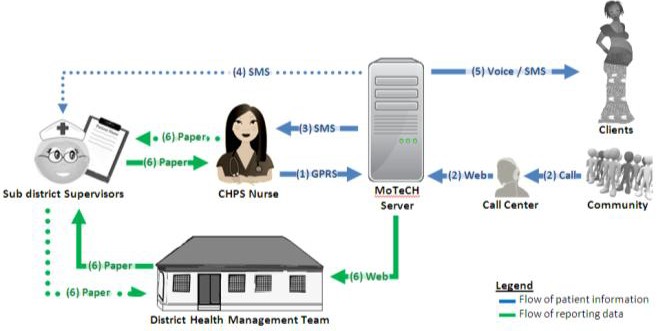
Voice messages are delivered in English or local languages. Two languages of the Upper East Region, Kasem and Nakam, were supported for MOTECH’s first implementation. SMS messages are all delivered in English. The MOTECH system helps community health workers to record and track the care delivered to women and newborns in their area. Each rural health facility is equipped with low-end mobile phones on which the MOTECH Java application for health workers is installed. Nurses enter data about patients’ clinic visits into forms on the mobile phone and send this to the MOTECH servers. The MOTECH system then checks patients’ healthcare information against the schedule of treatment recommended by Ghana Health Service for that care event. If the system sees that a patient has missed care that is part of the advised schedule, the Mobile Midwife service sends a message to remind the patient to go to the clinic for that particular service. Meanwhile, the healthcare worker is informed when the patient becomes overdue for treatment so that they can follow up with them and reduce the number of clients defaulting for recommended healthcare. Using the data nurses have submitted to the server, MOTECH also generates many of the monthly reports that facilities are required to submit to their district and regional management offices. Previously these reports had to be compiled by hand; a process that took three to four days. Healthcare workers can also use the MOTECH Nurses’ Application to query the database , enabling them to retrieve lists of patients overdue for care, women due to deliver in the next week or details about individual clients.
MOTECH uses low-cost GSM mobile phones to capture, transmit and treat health data collected by community health workers during client encounters. The system uses a Java 2 Platform Micro Edition (J2ME) application to capture client data and store it on a mobile phone. GPRS is then used to transfer this data from the phone to a central patient electronic medical records system (based on OpenMRS) that is stored on the MOTECH server. The MOTECH system analyses this client data against proper care regimens to determine due dates for certain care events and sends reminders to healthcare workers and clients for these events. The client data collected is also aggregated to automatically generate nurses’ monthly report [3].
Lessons Learnt
While the first phase has been implemented, it offers a unique opportunity to learn the weaknesses of the project which can be avoided in all future phases. The important lessons learnt are as mentioned below:
- Build on an existing policy – Providing nurses with handsets required coordination with GHS management to coordinate a handset policy that addressed loss, theft and other issues related to the use and misuse of the phone [3].
- A lot needs to happen to deploy phones – The logistics of purchasing and setting up more than 40 mobile phones with updated versions of the MOTECH forms, ensuring that they were charged, adding credits, deploying them, and training everyone on their use was an ongoing effort that required weeks of in-person field-staff visits, as well as a coordinated effort with the field staff to ensure that in the early days – when updates to the forms were frequent – all the phones were updated correctly, the time zone on the phone was set properly, and phones were labeled and tracked [3].
- Use the same handsets – Having everyone use the same type of phone did prove to make the initial and ongoing training process easier to explain and understand. It also meant that nurses could be held more directly accountable for the phones than if they were using their own phones [3].
- Plan for network un-reliability – The network is often spotty and unreliable; even bad weather can result in lost coverage. With java forms, nurses are able to upload their completed mobile forms and send them once they are in range of a functioning network [3].
- Constant encouragement is required for successful adoption: Regular reinforced encouragement, particularly from peers, is a critical part of adopting new tools and practices. Encouragement messages in SMS messages are also a really effective way of keeping nurses motivated, as well as a useful channel for reminding them of certain practices such as uploading all forms before the end of the month. These messages are especially effective if they demonstrate effective monitoring of nurses’ work and are tailored to that. For example, saying “We have noticed that you have uploaded 100 forms today. Congratulations on all the hard work. Enjoy the evening” shows the nurse that you see the work they are doing and it is valued. Similarly, messages notifying the nurses that the number of uploads they have made for the day look low, lets them know that someone is monitoring that they are using the application reliably. These personalized messages are currently generated by support center staff and are well worth the effort. Over time, as the system scales, the messages can be generated automatically [3].
- Integrate the project into responsibilities set by the employer, not the project. Having an intervention introduced by the users’ employer makes them more likely to adopt it as part of their existing work and accept it as a change to their existing work, rather than additional work for an outside entity. This is important in encouraging adoption and compliance. We also noticed a change in the dynamics when district directors were including in project steering committee meetings. Frequent visits by the district directors, regional director, and national Ghana health Service staff at site visits each month created a visible sense of the importance and priority of the project and senior Ghana Health Service Staff and therefore among the community health staff [3].
Analysis for Future Work
- Cost Analysis – An analysis of the cost should include providing basic handsets initially, supporting the handset use over time and replacing them approximately every two years. Data transmission costs for sending information over GPRS are extremely low and unlikely to significantly impact implementation budgets [3].
- Logistics Plan – Scaling this to a larger set of users requires an aggressively proactive plan for handling how phones are ordered, how phones are set up initially (e.g., time and date, initial loading of forms, phone charging) and how they are distributed, updated and replaced over time [3].
- Policy Development – It is imperative that a policy be developed (if working with a government health service, it must be in accordance with their policies) to address how loss, theft and misuse of phones will be handled [3].
- Monitoring Methods - Monitoring and encouragement requires real time access to meaningfully presented data. The creation of effective monitoring tools needs to be one of the software development deliverables. In addition, manageable and efficient processes for communicating regularly with users need to be in place [3].
Informational Videos of Mobile Midwife Project
1 Ghana Millennium Development Goals Report.
2 WHO: World Health Statistics. In Health Status: Mortality. Geneva: World Health Organization; 2006, In Health-related Millennium Development Goals. Geneva: World Health Organization; 2009.
3Grameen Foundation – MOTECH in Ghana: Early Lessons Learned.